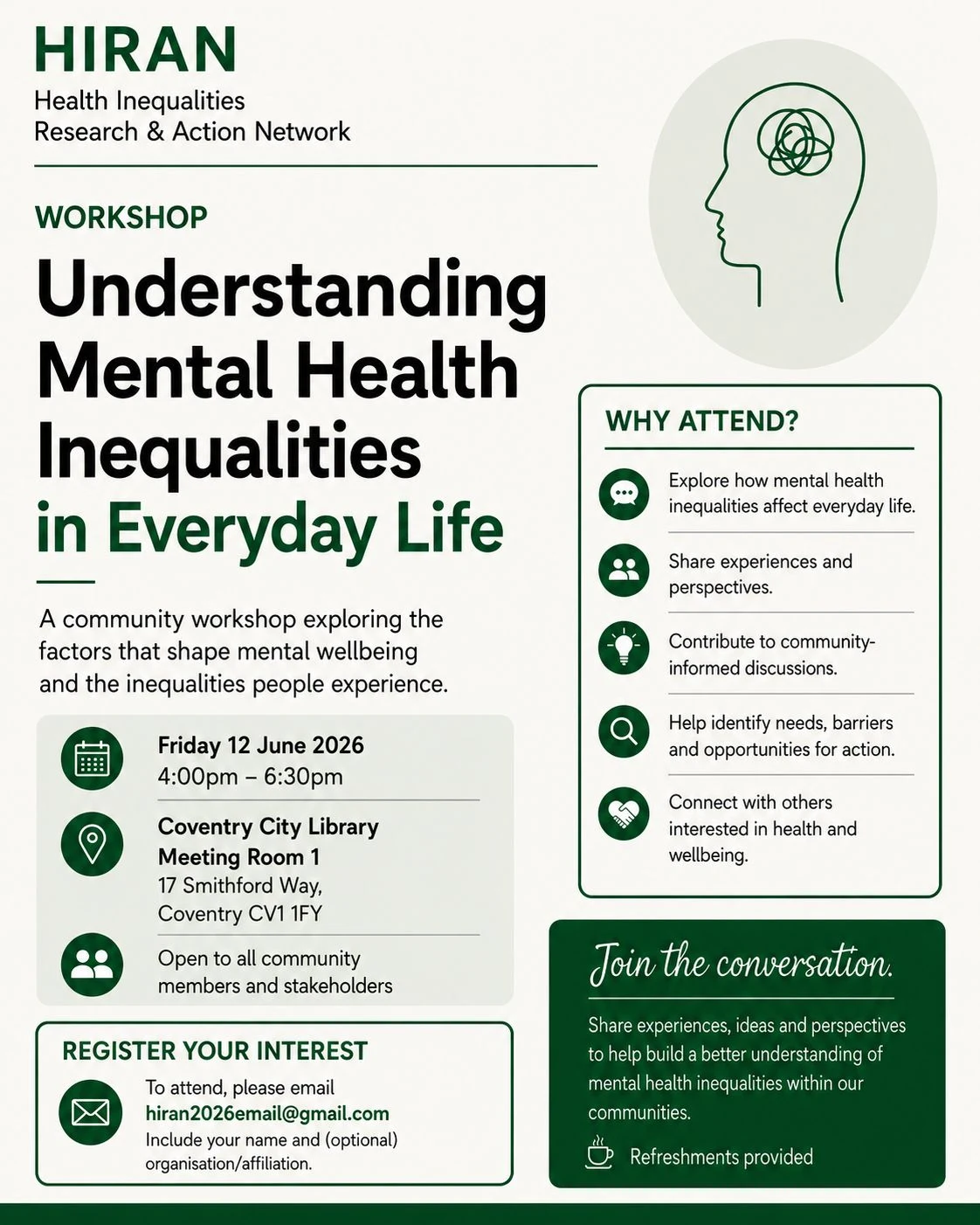
12 June 2026 · Coventry City Library, Meeting Room 1
The purpose
HIRAN’s first public-health workshop explored the social, economic and environmental circumstances affecting mental wellbeing. It introduced wider determinants of health, surfaced community perspectives and identified needs, contributing factors and gaps in support.
Who led the conversation
The workshop was led by Rukayat Shittu, Usoro Akpan and Ibrahim Khalil Ja’afar. Arrival and registration began at 4pm; the formal welcome began at 4:15pm. The advertised session ran until 6:30pm.
How we explored it
The session included a “Mental Wellbeing in One Word” icebreaker, a short presentation, guided discussion, small-group work on needs, causes and gaps, networking, a roundtable and individual reflection.
What participants raised
Discussions connected mental wellbeing with housing, financial security, employment, education, social support, access to healthcare and public policy. Participants also raised stigma, limited awareness and unequal access to appropriate support.
What participants valued
The interactive group activity, open discussion and opportunity to hear different perspectives were particularly valued. Participants described the importance of a welcoming space for a potentially sensitive discussion.
Evaluation findings
Eight people completed the evaluation. All eight rated the workshop 5/5, strongly agreed it was well organised and welcoming, and indicated interest in future HIRAN activities. Respondents also reported increased understanding of mental-health inequalities and wider determinants.
What these findings can tell us
These findings describe the experiences and perspectives of the respondents. The sample was small (n=8), potentially influenced by self-selection, and captured at one point in time. The exploratory discussion is not representative of Coventry as a whole, and satisfaction ratings do not demonstrate improved health outcomes.
Recommended next steps
Continue community engagement, strengthen mental-health education and awareness, and seek broader participation. Future conversations can explore housing, financial wellbeing, loneliness, access to services, resilience and cultural inclusion. Community-informed recommendations and collaborative work can help move learning towards action.
Source and status
Public summary based on HIRAN’s workshop report and the supplied Website Source Pack. It distinguishes participant feedback, interpretation and recommended next steps. This is community-engagement documentation, not a peer-reviewed study.